

Wave Watching

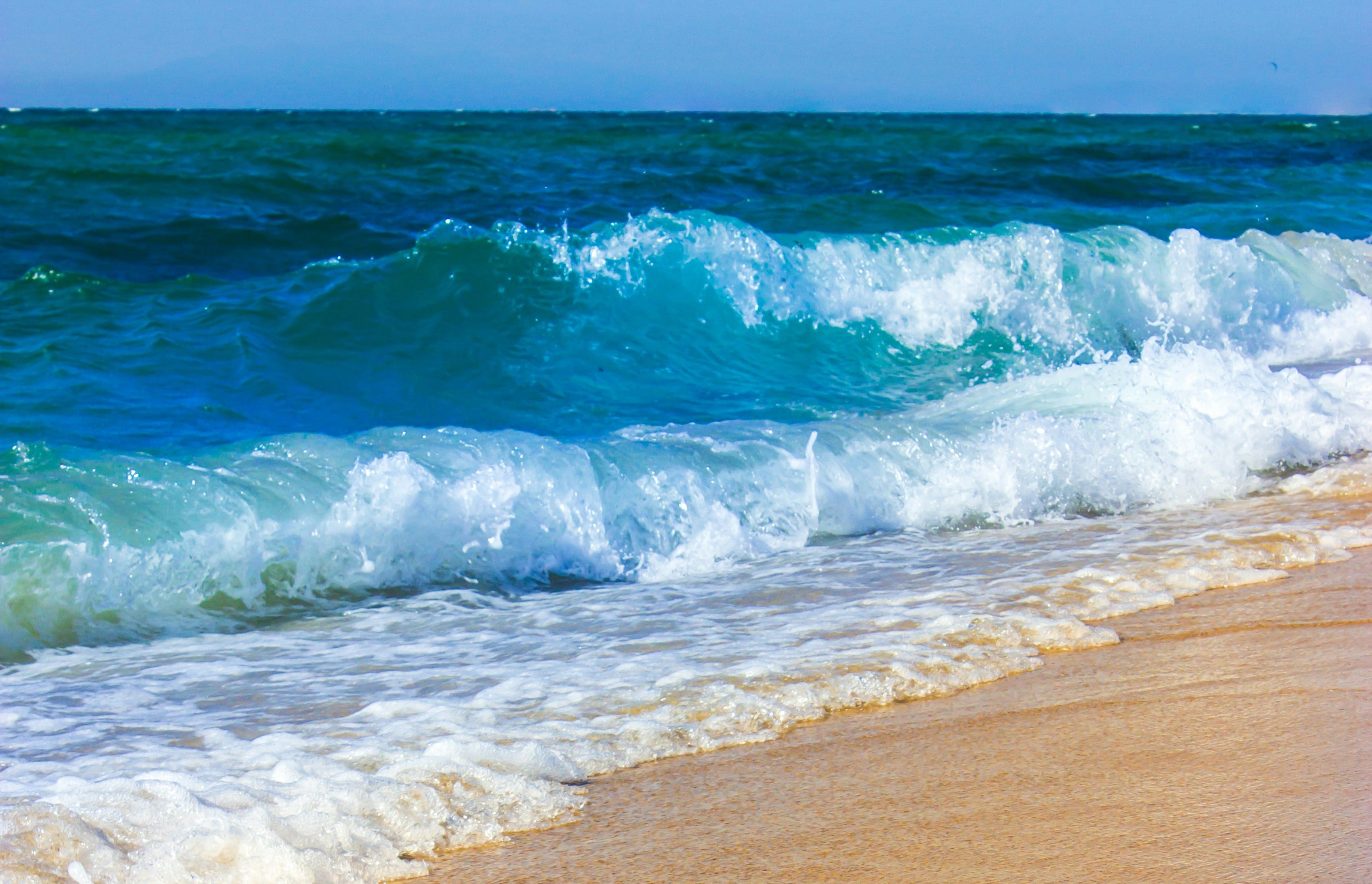
I had planned to make today’s column the third and final in a series about rising sea-level in the Bay, focusing on two local case studies. I’ve decided to delay that column until after a public meeting in Cambridge on May 27th. The latest design for the Cambridge project will be presented and I want to explore those plans in the final column. I hope you’ll find that it’s been worth the wait.
I have a related topic to explore today. It unpacks the processes that loom large in any discussion of Chesapeake Bay. More than 500 islands have disappeared since European settlers came to the shore, and scores are threatened today.*
I hope this column also proves valuable to beach vacationers. Print out a copy, tuck it into the bag with sunscreen and reading material, and read it with family (especially children and grandchildren) as you watch the waves roll in.
What are we really seeing as we stand on an Atlantic beach on the Eastern Shore, watching waves roll in?
Wind-generated waves are approaching the shore over an even sand bottom. As waves continue toward you, there is progressively less water below the crest of each wave. They begin to ‘feel’ friction with the bottom as it gets shallower. The bottom slows down while the top continues at the same speed, causing the wave to get taller. The top of the wave eventually falls forward (it ‘breaks’) because the bottom water has been stopped by friction with the bottom. The same thing would happen if someone riding down a crowded escalator stopped immediately after stepping off at the bottom. I won’t try to describe what happens next.
The wave particle motion inside a breaking wave is chaotic and random, and it scours the sediment on the bottom like a power-washer. After the wave breaks, the water slows down, gravity takes over, and the water washes downhill, depositing the sand as a smooth layer.
What if the bottom under the approaching wave wasn’t smooth? What if there were underwater plants on the bottom, or an area of rocky bottom, or an oyster reef? The bottom of the wave would slow sooner, causing it to break over the rough patch farther offshore. Some beaches have underwater sandbars a distance from the beach; you’ll see waves breaking over them. The distance to the beach isn’t enough for the wind to generate new large waves.
Notice that the crest of a wave may not break in unison along its length. It often breaks the way a slider moves along a zipper. As the point at which the wave breaks travels along the beach, some of the wave’s energy is directed along the beach instead of straight toward shore. Each breaking wave is still scouring sand off the bottom but it moves the sand diagonally along the beach. That’s called longshore drift.
The beach is acting like a conveyor belt, transferring sand in the direction the wind is pushing the waves (to the left in the photo). If you’ve been floating in the surf and found yourself far from your beach umbrella, it’s because you had been a large particle experiencing longshore drift.
The Barrier Islands of the Outer Banks are in slow but constant motion, eroded by ocean waves at one end and growing at the other. Since the prevailing winds come out of the northeast, longshore drift moves sediment from north to south. Channels between the islands need to be dredged periodically to provide enough depth for boat traffic.
As the final column will explain, these principles are critical to shoreline protection and flood mitigation. Don’t try to stop the force of powerful waves where they break on the shore. Slow them down before they reach it.
Coral reefs, mangrove swamps, kelp forests, and other biological structures provide natural buffer zones that slow incoming storm waves. As the waves slow and break, they deposit the sediment being carried, replenishing the bottom instead of eroding it.
Photo credit:
* The Disappearing Islands of the Chesapeake presents the histories of islands in the Bay that are disappearing below the waves and a list of those that have already disappeared.
____________________________________
David Schindel is a retired research scientist living on Maryland’s Eastern Shore since 2023. He studied evolution and the fossil record, taught at Yale, worked at the National Science Foundation, and led several international R&D projects for the Smithsonian. David became a weekly Spy columnist in March 2026, writing about the puzzles and challenges we may face. His columns connect them to deeper patterns and structures in our society, our government, or our ways of thinking, usually through a case study drawn from the news. His columns and other essays can be found here.